- Tried Korean before and stalled? This book is built around why that happens — not around more words to forget.
- Don't know Hangul yet? Watch the video above — you'll be reading it in three minutes.
- Follow Korean shows without subtitles? Every word here is chosen so you can catch what's actually said.
WHY THIS HAPPENS
A word alone on a page cannot teach you to say anything.
You can recite three hundred words. Someone asks you something in a shop and nothing comes out. That is not a memory problem — the words went in as facts instead of tools, and recognising a word is a different skill from producing one.
Underneath that, something quieter is happening. Months go by studying vocabulary and grammar without once training the mouth or the ear. At conversational speed, near-identical sounds are impossible to tell apart, because you have never had to.
At first it is one pause before speaking. Then it is a habit. Then it is years of resistance built up around the sound of your own voice — and by then the problem is no longer Korean. You have taught yourself not to speak.
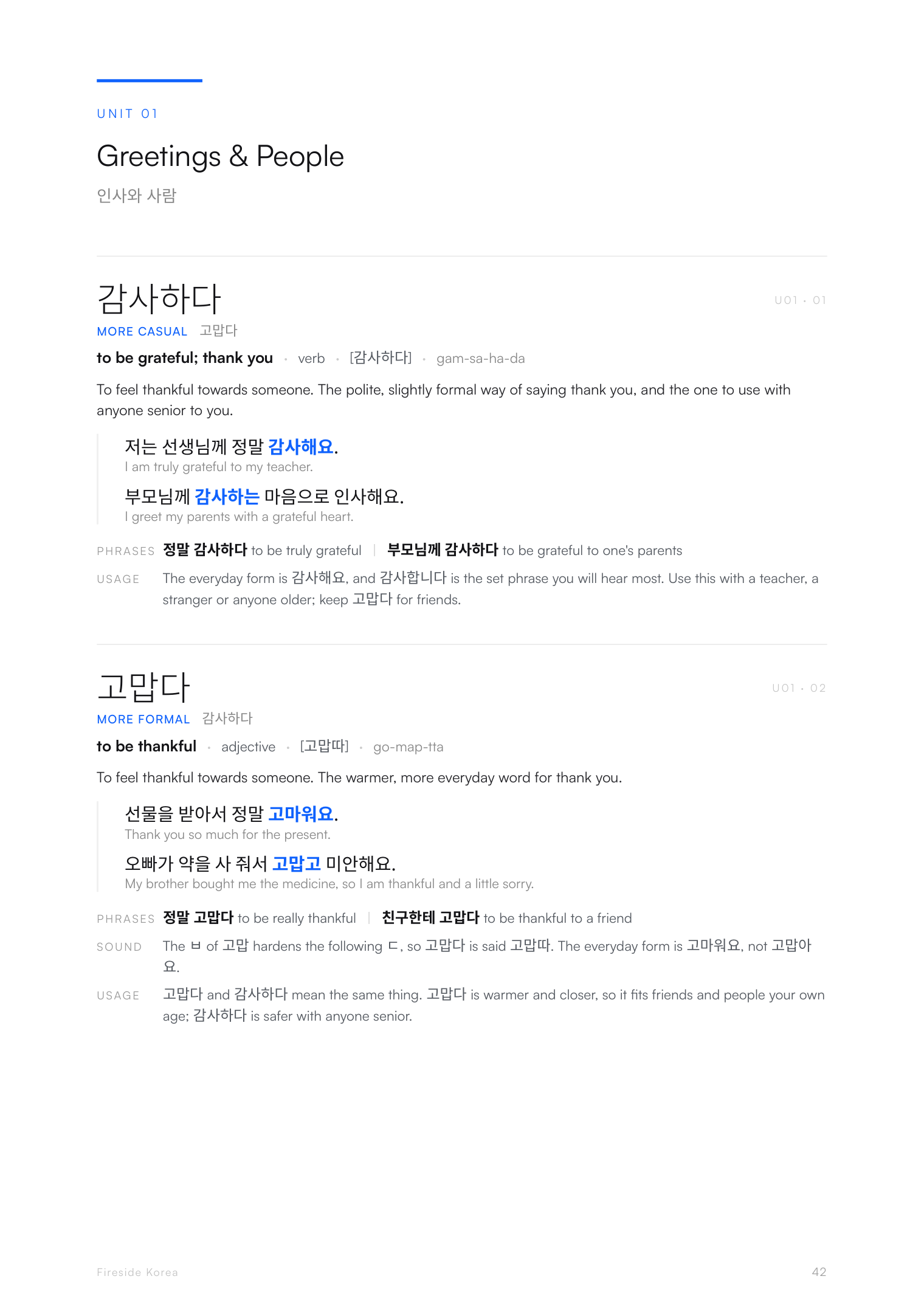
저는 선생님께 정말 감사해요.
You already know 감사하다 means "thank you." This book is what gets you from the word to that sentence.
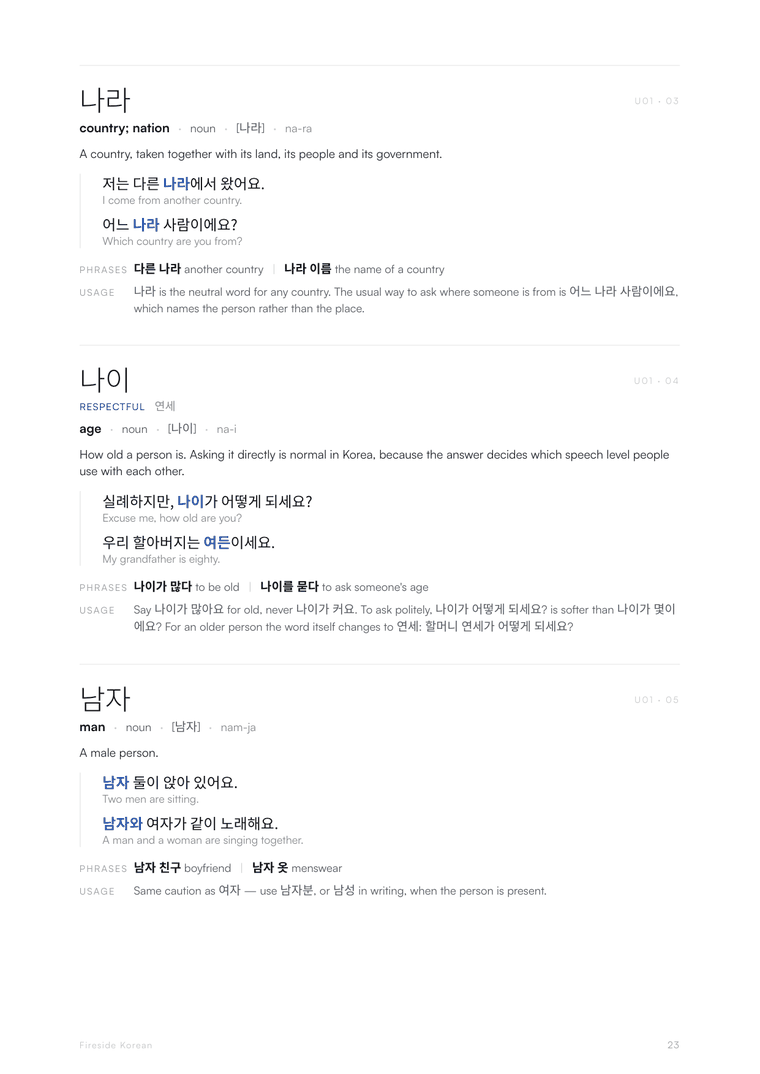
So no word in this book is ever alone on the page. Every one arrives inside two sentences — not so you can recognise it, but so you have a way to say it.
THE BOOK
This is what lands in your inbox.
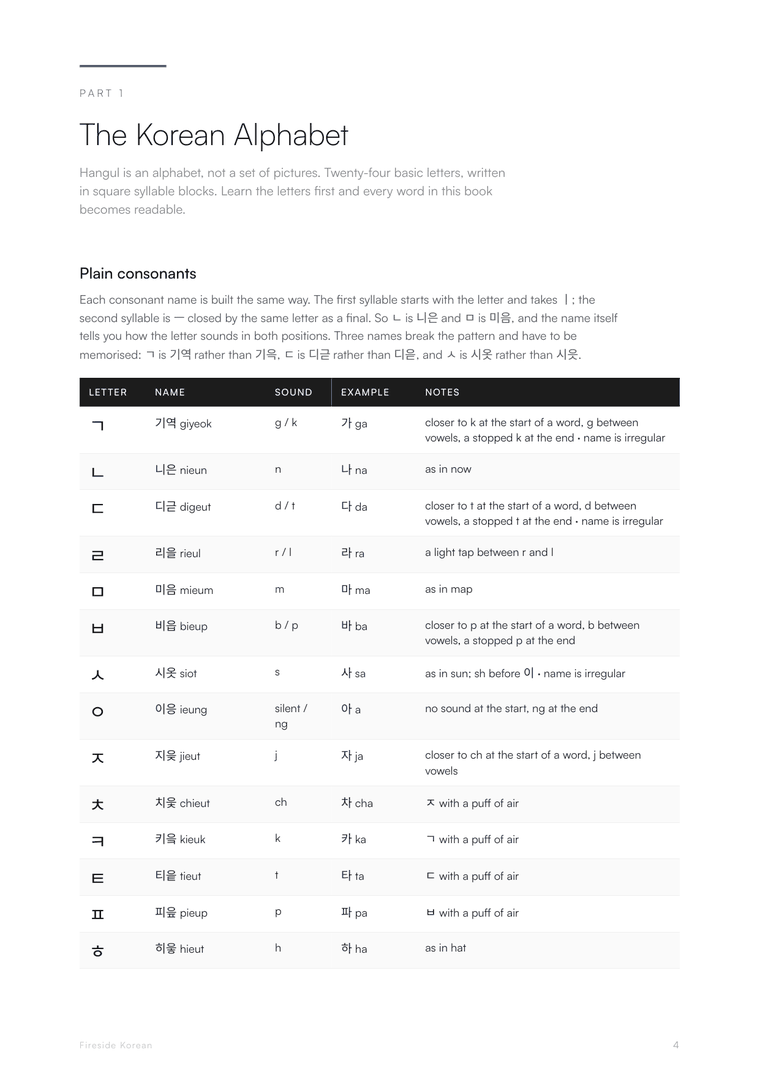
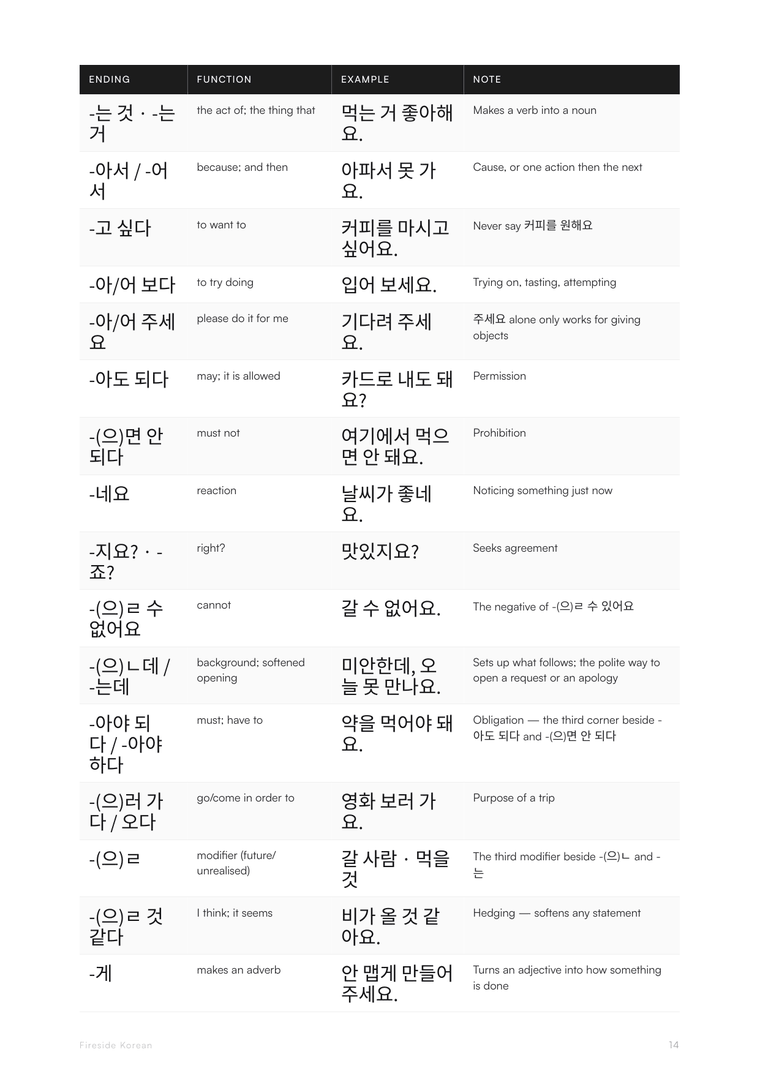
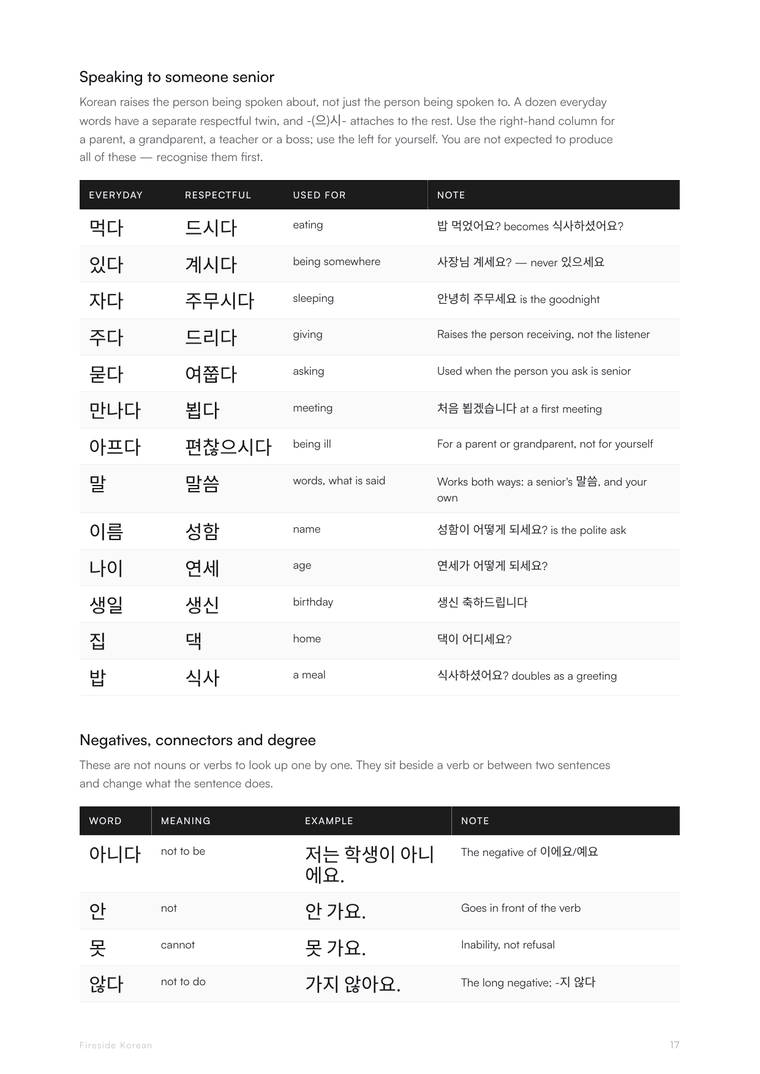
Not a teaser chapter. 171 pages, typeset properly, the same file whether you ever buy anything or not.
HOW IT WAS MADE
We threw the first version away.
-
300 → 423 words
The frequency list did not survive contact with reality.
The first draft was 300 words ranked by how often they appear. Common words scatter across every topic, so no unit held together and a learner had nowhere to put anything. We rebuilt the list around eighteen situations instead, and it grew to 423.
-
13 respectful pairs
Nobody postponed the politeness problem.
Korean changes shape depending on who is listening, and getting it wrong does not make you incorrect — it makes you sound rude. Thirteen everyday words are given here with their respectful twin from the start, and every sentence was checked to make sure it addresses the right person.
-
846 sentences
Every sentence was written for this book.
846 of them, none lifted from a dictionary — which is why they sound like something a person would say rather than something a corpus would contain.
-
90 found · 84 adopted
The person who checked them had not written them.
Three separate blind reviews: one tested whether the book could handle twelve everyday scenes, one read all 846 sentences and marked only the ones that felt wrong, one tested the respectful forms.
-
Every build, zero exceptions
The rest is checked by machine.
No word appears that the book has not taught. No sentence uses a verb ending outside the endings table. No two entries share an example. The build refuses to produce a PDF if any of that fails.
THE PATH
Eighteen units, and then you're done with the beginner stage.
Each unit here is a place you actually stand — not one of seventeen hundred lessons with no finish line.
- 01Greetings & People
- 02Family & Relationships
- 03Body & Health
- 04Food & Eating
- 05Home & Living
- 06Clothes & Appearance
- 07Time & Dates
- 08Place & Direction
- 09Getting Around
- 10Shopping & Money
- 11School & Studying
- 12Work & Jobs
- 13Weather & Nature
- 14Leisure & Hobbies
- 15Feelings & Personality
- 16Talking & Communication
- 17Everyday Actions
- 18Describing Things
ALSO IN THE FREE BOOK
The grammar comes with it.
- 35 verb endings in one table — the ones that actually appear in the sentences
- 19 particles, with the rule for which form follows a consonant and which follows a vowel
- Thirteen respectful word-pairs — 집 becomes 댁, 먹다 becomes 드시다, 나이 becomes 연세
- 110 pronunciation notes for the places where spelling and speech part ways
- 380 usage notes for words that behave in a way English does not lead you to expect
- 846 collocations — the phrases each word actually lives inside
- Hangul from the first stroke: 14 consonants, 5 tense pairs, 21 vowels, 7 final sounds
Take the book. Decide later.
It costs nothing and it's the whole thing. If the writing isn't for you, you'll know within ten pages and you won't have spent anything.
BEFORE THE BOOK
A few nosy questions
Relax — this isn't a background check. It's just how we know what to write next.
Sign-up form is almost ready. For now, email hello@firesidekorea.com and we'll send you the book by hand.